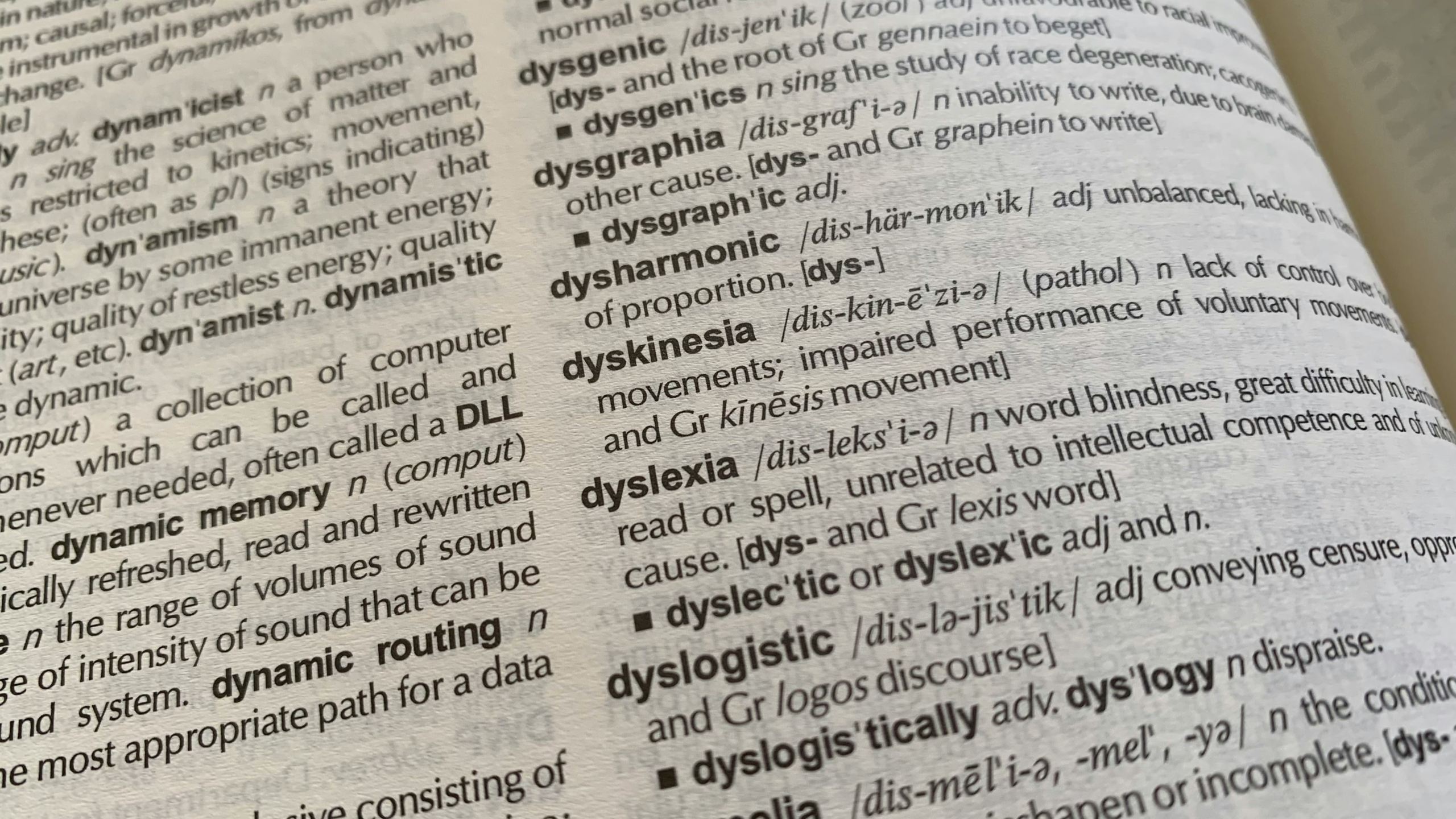
Originally published on 8/14/24 as “Some Medical Vocab”
People use words like disability, disorder, and conditions to describe brains that work in different ways. Learning what these words mean can help you understand your strengths. When you know your strengths, you can find smart ways to handle challenges—and keep following your passions.
- Condition: A label for a group of physical, mental health, or brain-based challenges that can make everyday life harder.
- Developmental Condition: Brain‑based conditions that last a person’s whole life and usually show up in childhood. They can make it harder to learn, remember, and do everyday things. This can cause challenges with school, work, and relationships. I like to call them neurodivergent conditions.
- Disability: A physical, mental, or brain‑based condition that makes daily activities harder and can affect how someone lives or is treated by others.
- Disorder: When the body or brain doesn’t work as expected, often because of illness, genetics, or an accident.
- Diagnosis: A label that helps explain why someone may think, learn, feel, or act in ways that cause challenges for them and other people.
- Diagnostic and Statistical Manual (DSM): A guide doctors use to diagnose mental health and neurodivergent conditions. The current version is the DSM-5-TR.
- Mental Health Conditions: Brain-based conditions that make it harder to handle stress and emotions. They can change over time and may make it harder to cope with stress, sometimes in ways you can’t see.
Common Neurodivergent Conditions
- Attention Deficit Hyperactivity Disorder (ADHD): Can make it harder to manage attention and emotions. People with ADHD may have lots of ideas, think quickly, and sometimes need to move more (hyperactivity). But they are also creative and strong advocates for change.
- Nonverbal Learning Disability (NVLD/NLD): People with NVLD are often good at saying and writing how they feel but think, plan, and connect with others differently. This can make school, work, relationships, and everyday life harder. NVLD isn’t in the Diagnostic and Statistical Manual, so many doctors don’t know about it. That can make it hard to get diagnosed and treated correctly.
- Specific Learning Disability (SLD): Conditions that make reading (dyslexia), writing (dysgraphia), or math (dyscalculia) hard. Many people with dyslexia are good at understanding pictures and patterns.
- Autism Spectrum Disorder (ASD): Makes it harder to understand hidden clues about what others mean and other social skills. People with ASD may also struggle to understand their own thoughts and feelings and can be sensitive to sensory signals, like sounds or lights. Many have amazing attention to detail.
- Tourette Syndrome: A condition that causes repeated movements or sounds (tics) that are hard to control.
Common Mental Health Conditions
Here are some of the mental health conditions that people who are neurodivergent are more likely to experience:
- Many of us tend to feel rejection more, especially when other people send signals that they don’t like you through their words or actions. It can even feel so intense that you worry a lot about what other people might think of you. Experts call this Rejection Sensitivity Dysphoria, even though it’s not in the DSM.
- Major Depressive Disorder: Feeling sad and not wanting to do things you like for a long time. You might eat or sleep more or less than usual.
- Generalized Anxiety Disorder: Worrying a lot about things that already happened, could happen, or might happen. Your body may feel tense, and you might have trouble sleeping.
- Social Anxiety Disorder: Feeling so nervous or embarrassed around other people that you want to be alone.
- Obsessive Compulsive Disorder (OCD): Having strong, repeating thoughts that something bad will happen (obsessions), which make you feel like you have to take certain actions (compulsions) to stop the thoughts.
- Bulimia: Eating a lot very quickly until you feel uncomfortable and have trouble stopping(binging). Then feeling so upset that you try to get rid of it by throwing up, taking lots of laxatives, or exercising too much (purging).
- Binge-Eating Disorder: Eating a lot of food very quickly, feeling uncomfortable and having trouble stopping (binging). You feel very upset, but you don’t purge.
- Avoidant-Restrictive Food Intake Disorder (ARFID): Not eating enough food, or avoiding certain foods, because of sensory issues, fear, or not feeling hungry. It’s not about weight or looks, but it can still be unhealthy.
- Post-Traumatic Stress Disorder (PTSD): Feeling very anxious or sad for a long time after something really scary happens. You might feel on edge a lot—especially when something reminds you of what happened—so you avoid it, and you might also have trouble sleeping.
Note: Many neurodivergent conditions share challenges with mental health conditions.
There are other mental health conditions, and getting support as soon as you can is important. Talk to someone you trust, like a family member, friend, school counselor, doctor, mental health professional, or social worker.
If you or someone you know needs someone to talk to right away, call or text the 988 Suicide & Crisis Lifeline. It’s just three numbers: 988.
Note on Health Issues and Neurodivergence
People with some medical conditions are more likely to have neurodivergent traits, even if they don’t have a diagnosis. These conditions include:
- Turner Syndrome
- Ehlers-Danlos Syndrome
- Epilepsy
- Down syndrome
- Williams syndrome
- Autoimmune disorders
- Food allergies and sensitivities
References
- American Psychiatric Association. (2022). Anxiety Disorders. Diagnostic and statistical manual of mental disorders (5th ed., text rev.).
- American Psychiatric Association. (2022). Eating Disorders. Diagnostic and statistical manual of mental disorders (5th ed., text rev.).
- American Psychiatric Association. (2022). Mood Disorders. Diagnostic and statistical manual of mental disorders (5th ed., text rev.).
- American Psychiatric Association. (2022). Neurodevelopmental Disorders. Diagnostic and statistical manual of mental disorders (5th ed., text rev.).
- American Psychiatric Association. (2022). Obsessive-Compulsive and Related Disorders. Diagnostic and statistical manual of mental disorders (5th ed., text rev.).
- Centers for Disease Control and Prevention (2022). Developmental Disabilities. https://www.cdc.gov/ncbddd/developmentaldisabilities/index.html
- Children’s Hospital of Philadelphia. (2017, July 1). Autism’s Clinical Companions: Frequent Comorbidities with ASD. Children’s Hospital of Philadelphia. https://www.chop.edu/news/autism-s-clinical-companions-frequent-comorbidities-asd
- Donaghy, B., Moore, D., & Green, J. (2023). Co-Occurring Physical Health Challenges in Neurodivergent Children and Young People: A Topical Review and Recommendation. Child Care in Practice, 29(1), 3–21. https://doi.org/10.1080/13575279.2022.2149471
- Frolov, L., & Schaepper, M. A. (2021). What Is Specific Learning Disorder? American Psychiatric Association. https://www.psychiatry.org/patients-families/specific-learning-disorder/what-is-specific-learning-disorder#section_5
- Hallowell, E. M., & Ratey, J. J. (2021). ADHD 2.0: New science and essential strategies for thriving with distraction—from childhood through adulthood. Ballantine Books.
- Klyce, M. (n.d.). Eating Disorders and Neurodiversity. National Eating Disorders Association. https://www.nationaleatingdisorders.org/eating-disorders-neurodiversity/
- Lalit, S. (2021, October 2). Difference between Disease, Syndrome, Disorder and Condition. Wecapable.com. https://wecapable.com/difference-disease-syndrome-disorder-condition/
- Lyons, H. (2021). How are Developmental Disorders Different than Mental Illnesses? https://withtherapy.com/therapist-insights/how-are-developmental-disorders-different-than-mental-illnesses/#:~:text=While%20developmental%20disabilities%20are%20typically,can%20also%20begin%20during%20adulthood.
- Minnis, H., & Gajwani, R. (2025, December 9). Beyond ACEs: When Trauma-Informed Care Misses Neurodivergent Children. The Association for Child and Adolescent Mental Health. https://www.acamh.org/blog/beyond-aces-when-trauma-informed-care-misses-neurodivergent-children/
- Naidodo, Uma. (2020). This is Your Brain on Food. Little, Brown Spark.
- National Institute of Mental Health (NIMH). (2019, June). Post-Traumatic Stress Disorder (PTSD) [National Institutes of Health (.gov)]. https://www.nimh.nih.gov/health/topics/post-traumatic-stress-disorder-ptsd
- Olivardia, R. (2023, June 28). The ADHD–Eating Disorders Link. Attitude. https://www.additudemag.com/adhd-linked-to-eating-disorders/
- Reling, J. (n.d.). Autism and Common Chronic Physical Health Issues. James Reling – Neurodivergent Therapy & Assessments. https://www.oregonneuroception.com/blog/autism-and-chronic-physical-health-conditions
- Resnick, A. (2023, November 2). What Does It Mean to Be Neurodivergent? Verywell Mind. https://www.verywellmind.com/what-is-neurodivergence-and-what-does-it-mean-to-be-neurodivergent-5196627
- Sulkes, S. B. (2022a). Definition of Developmental Disorders. Merck Manual: Consumer Version. The https://www.merckmanuals.com/home/children-s-health-issues/learning-and-developmental-disorders/definition-of-developmental-disorders
- Sulkes, S. B. (2022b). Learning Disorders. Merck Manual: Consumer Version. https://www.merckmanuals.com/home/children-s-health-issues/learning-and-developmental-disorders/learning-disorders